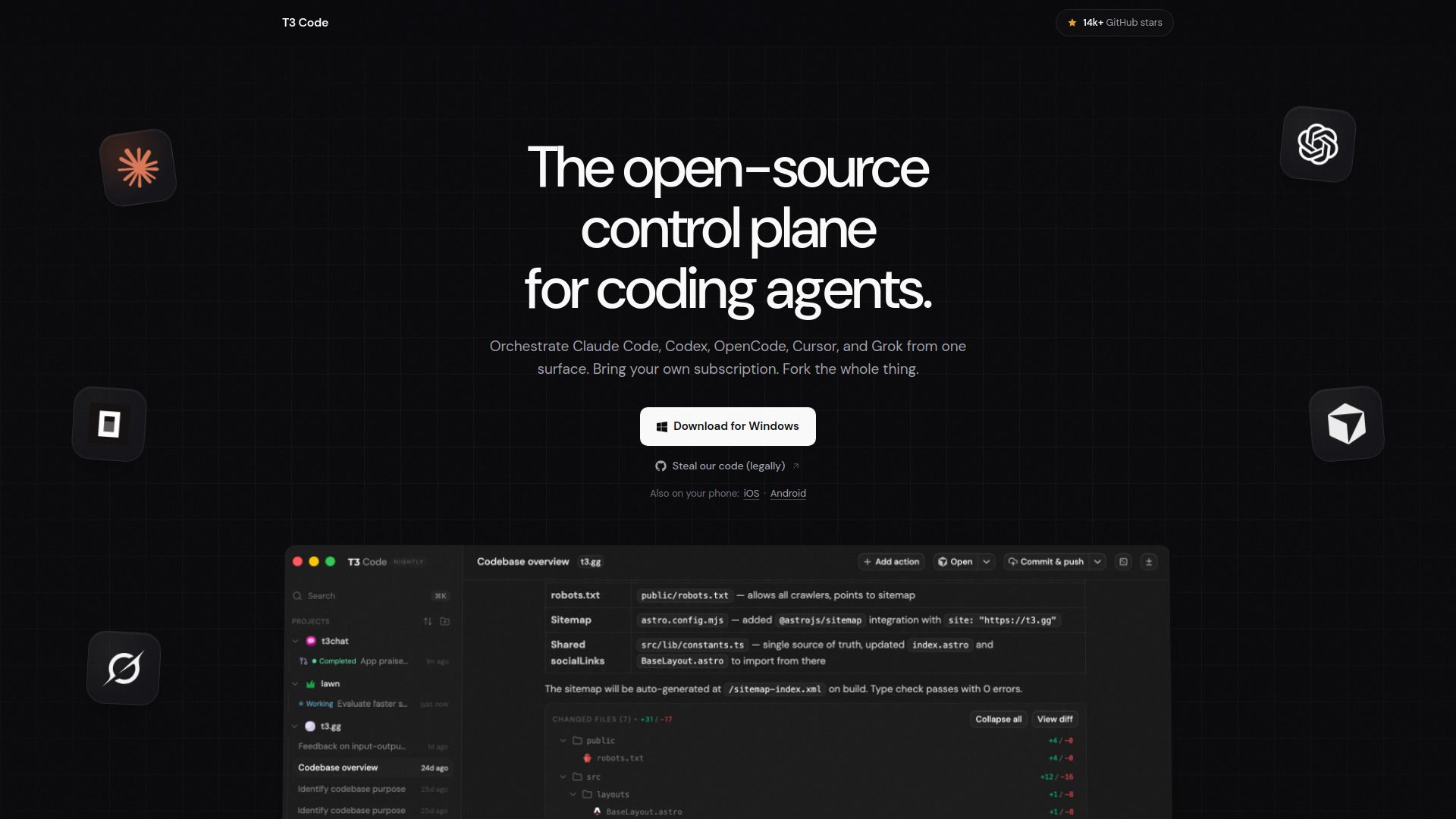
About T3 Code
What is T3 Code?
T3 Code is an open-source control plane designed for coding agents, allowing users to orchestrate various models such as Claude Code, Codex, OpenCode, Cursor, and Grok from a single interface. It is accessible on multiple platforms, including macOS, iOS, and Android, and is supported by a community of over 100,000 developers. Users can bring their own subscriptions and fork the code for personal use, making it a flexible tool for developers.
Some of the key features and benefits of T3 Code include:
Enhanced performance compared to traditional coding GUIs.
Support for a wide range of coding models and harnesses.
Open-source nature allows for customization and personal forks.
Community-driven development with active user feedback.
Focus on usability for Linux users.
T3 Code Features
T3 Code is an open-source control plane designed for coding agents, allowing users to orchestrate various models such as Claude Code, Codex, OpenCode, Cursor, and Grok from a single interface. This flexibility enables developers to bring their own subscriptions and customize their experience by forking the code to suit their specific needs. T3 Code is available for macOS, iOS, and Android, making it accessible across multiple platforms.
Some of the key features and capabilities of T3 Code include:
Integration with multiple coding models for enhanced functionality.
Open-source nature allows for customization and personal forks.
Performance optimization, providing a smooth user experience.
Support for Linux users, addressing a gap in the market.
Ability to plug in personal subscriptions without reselling tokens.
Why T3 Code?
T3 Code offers a range of benefits that make it a compelling choice for developers. Its performance is notably superior, providing a coding GUI that doesn't compromise on speed or efficiency. Users have praised its accessibility, allowing them to utilize their favorite models and harnesses from anywhere, which enhances productivity and flexibility in workflows.
Some key advantages of using T3 Code include:
Optimized performance that outshines traditional coding interfaces.
Support for Linux users, demonstrating a commitment to inclusivity.
Customizability, allowing users to create their own forks and tailor the tool to their specific needs.
Enhanced user experience through a well-designed interface that changes the interaction with models.
Learn more and.
Key Features
How to Use
Visit the Website
Navigate to the tool's official website.